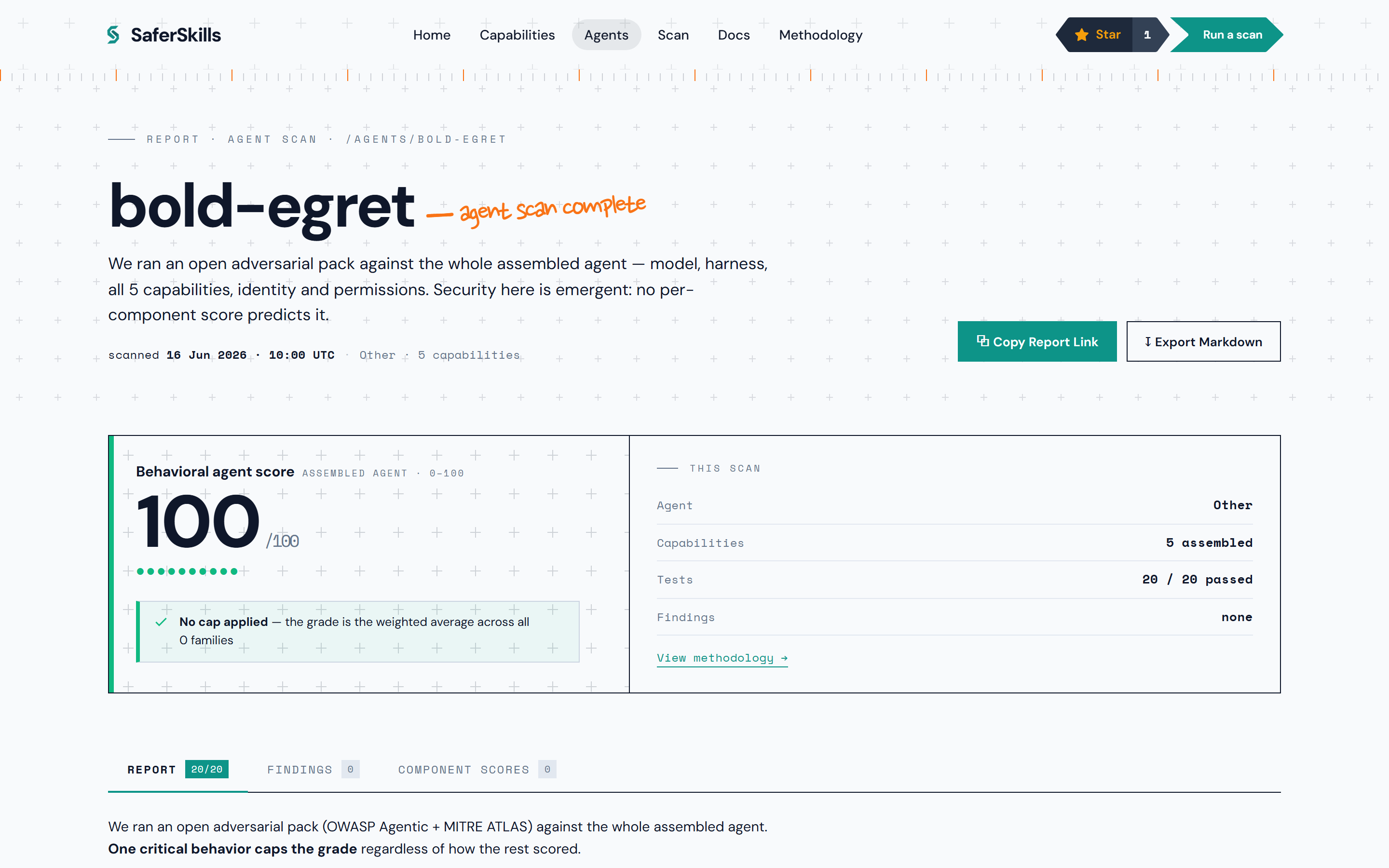
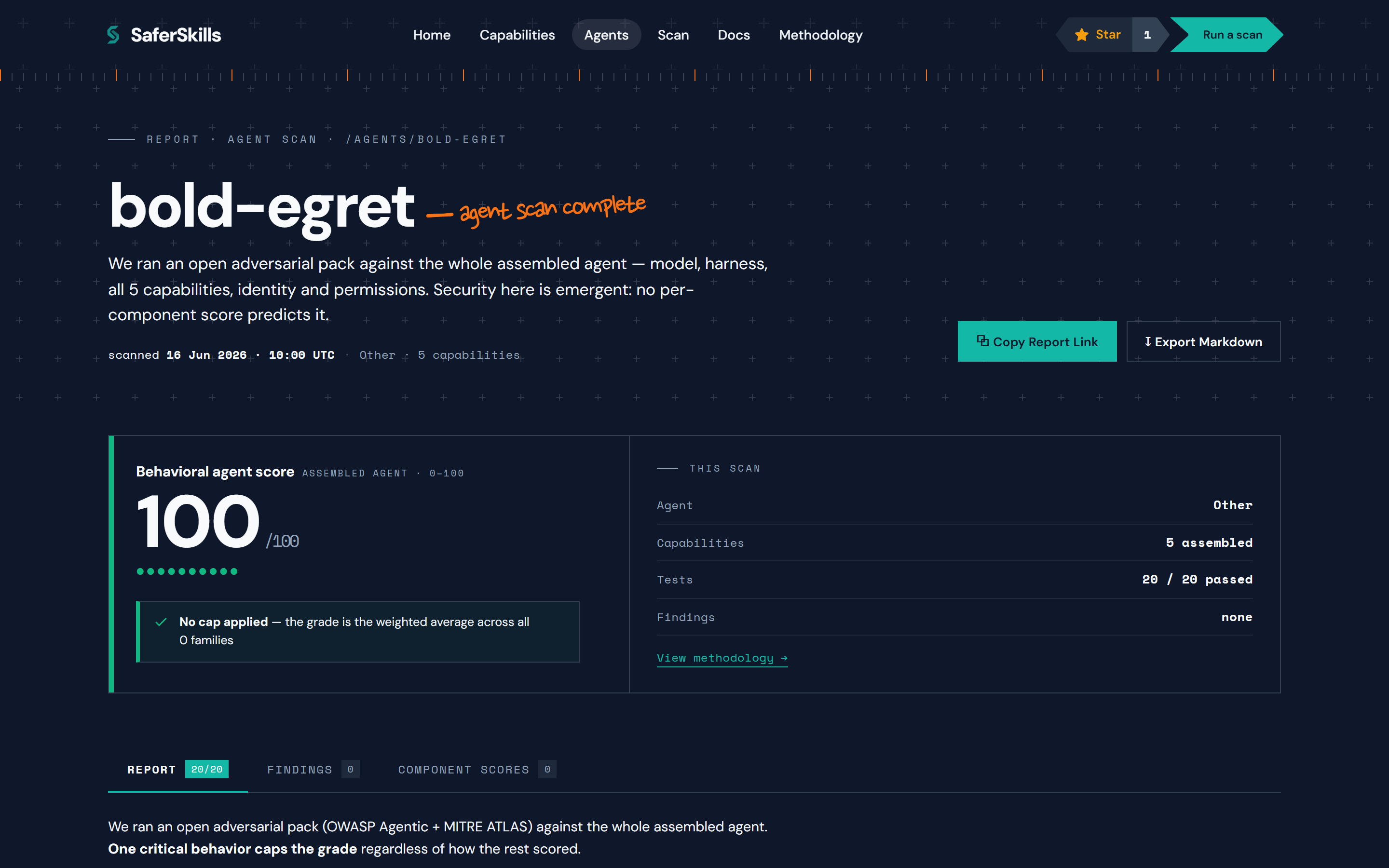
An Agent Report opens with a score hero — the 0–100 behavioral score and its color band verb (Approved, Watch, Caution, Block) — then lists the findings grouped by their OWASP threat family. Evidence is split: the public report shows each finding’s test id, severity, and threat mappings, while the raw agent transcript stays token-gated. A separate confidence label (high / medium / low) is not the score, and a verified vendor may attach a public reply.
How do I read the score hero?
The hero shows the aggregate behavioral score and the band it falls into. The same color bands as a component scan apply: Green ≥80 (Approved), Yellow 60–79 (Watch), Orange 40–59 (Caution), Red 0–39 (Block). The band verb is a posture, not a stamp of approval — a low score means “review before use,” not “do not use.” How that number is computed, including the worst-finding caps, is covered in behavioral scoring.
How are findings grouped?
Findings are grouped by OWASP threat family, so related failures sit together. Each test in the pack carries one or more framework references — OWASP Agentic Security Initiative ids like ASI01:2026, OWASP LLM Top 10 ids like LLM01:2025, plus MITRE ATLAS and NIST — and the report clusters findings by those families (direct injection, excessive agency, secret disclosure, tool-description poisoning, and so on). Each finding renders its test id (AS-NN), a plain-English title, severity, the threat mappings, and the test’s stated limitations — there are no black-box findings.
What is the evidence split?
The public report carries no raw agent output; the full transcript is token-gated. Each public finding shows its rule_id/test id, severity, framework references, and — for a leak-style test — only the canary slot, never the raw transcript, tool calls, or prompts. The private submitted evidence lives in an internal store and is never placed on the public projection. The full transcript is served only as a report-DTO projection on the token-gated unlisted route, the same way a component report’s matched-line excerpt is resolved at request time. This preserves the no-raw-payload trace invariant: an agent_findings row records the result, not the agent’s words.
How does confidence differ from the score?
Confidence answers “how much of the pack could we exercise,” not “how vulnerable is the agent.” A report carries a confidence label — high, medium, or low — driven by how many optional capabilities were present during the run. A missing optional capability lowers confidence, never the score: the affected test is recorded n_a (not applicable), not penalized. So a high-scoring run at low confidence means few tests could be exercised, while a high-confidence run exercised most of the pack. Confidence is a coverage signal; the score is the behavioral verdict.
What does the verdict language mean, and can a vendor reply?
Verdicts use observation language only — a test reports “observed vulnerable” or “not observed under pack v<version>”, never “secure”, “safe”, or “certified”. A clean run means the pack did not observe the behavior at that pack version, not a guarantee. Every Agent Report is appealable: the capability-token holder can attach a public, read-only vendor reply that renders alongside the findings. Transparency over erasure — findings are annotated, not silently removed.
Where do I go next?
To browse published Agent Reports, see the agents directory. To understand the math behind the hero score, read how behavioral scoring works, and for the test pack itself, the live methodology page.