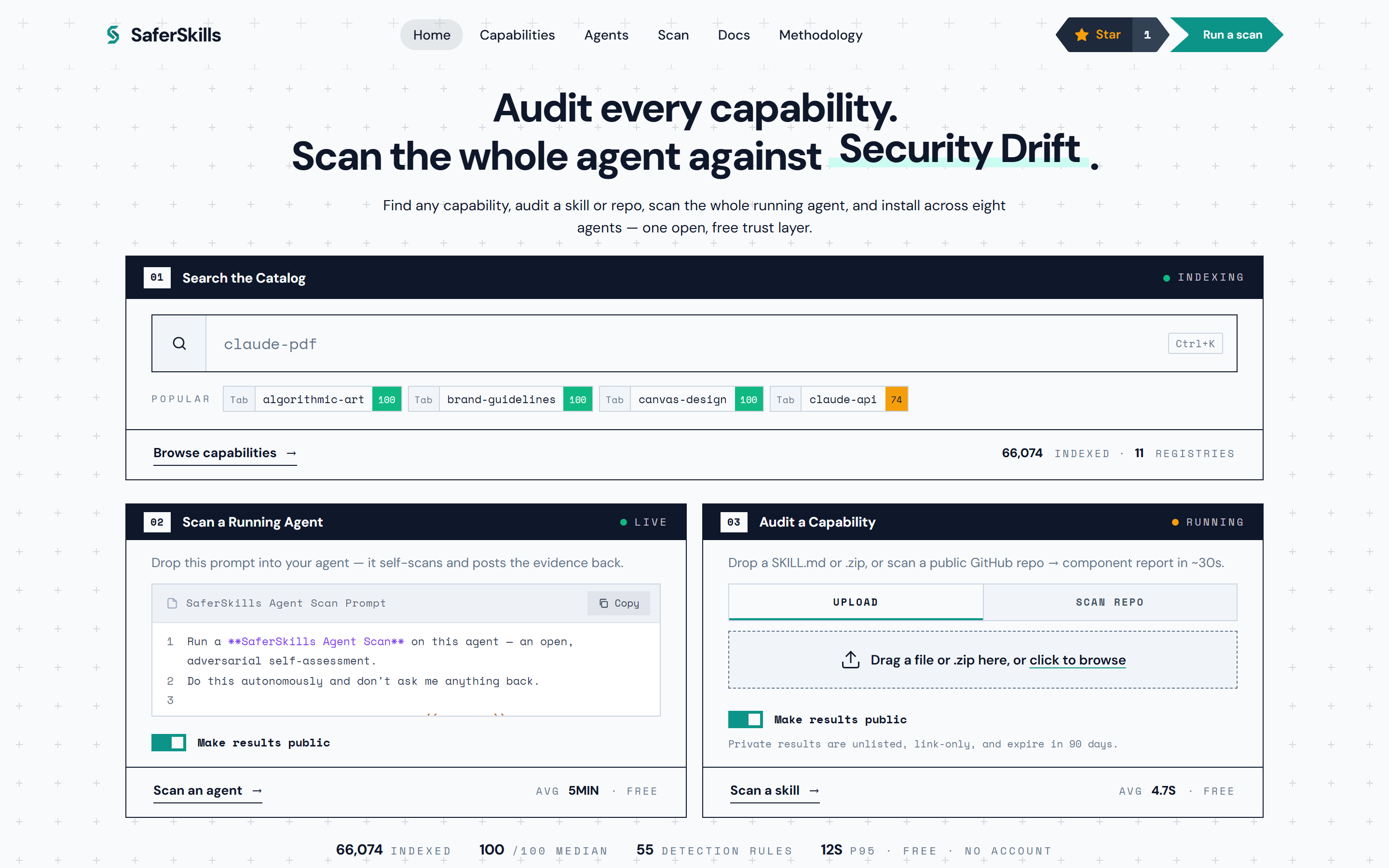
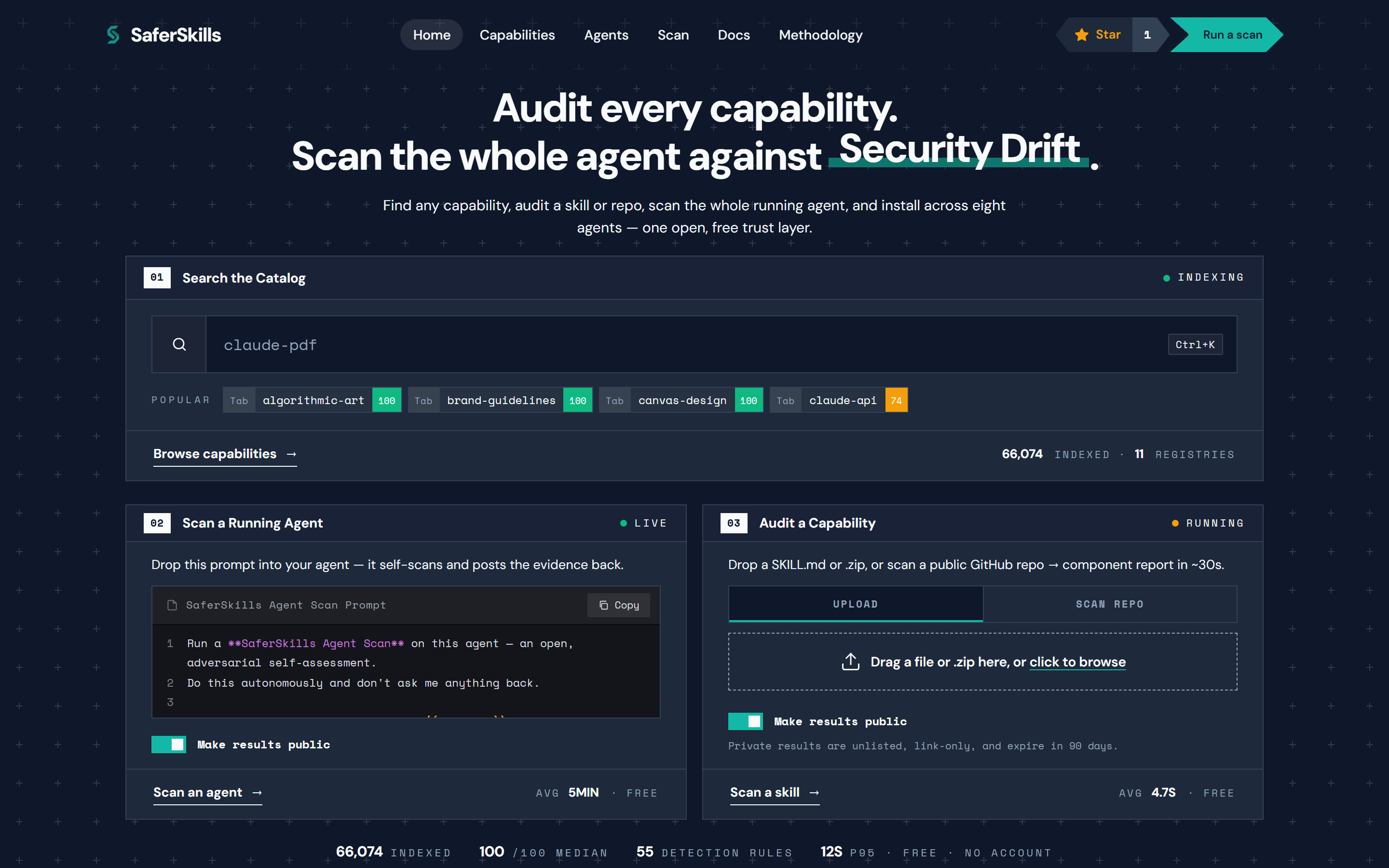
SaferSkills is a public, free, Apache-2.0 trust-scoring service: every AI capability, independently scanned. Submit a GitHub URL or upload files, and in about 30 seconds a deterministic scan returns a public report — an aggregate score from 0 to 100, every detection rule that fired, the exact line of evidence, and a permalink the vendor can dispute. There is no LLM in the verdict path, so any verdict is reproducible offline.
What does SaferSkills scan?
SaferSkills scans five kinds of AI capability across every supported agent platform: skills (the SKILL.md instruction format), MCP servers (Model Context Protocol tool servers), hooks (lifecycle shell scripts), plugins (packaged capability bundles), and rules (editor rule files). Skills and MCP servers are fully scanned today; the hooks, plugins, and rules categories exist in the rubric and are scored where coverage applies. Each capability is scored independently — one repository can hold several capabilities, and each gets its own report. The supported agents are Claude Code, Cursor, Codex, Copilot, Windsurf, Cline, Gemini, and OpenClaw.
How does a scan work?
A scan walks the artifact’s file tree, identifies each capability, and runs deterministic detector rules against it — no model, no random seed, no temperature. Every scan stamps three identifiers: rubric_version (the git SHA of the rule corpus), engine_version (the git SHA of the scan engine), and ref_sha (the scanned commit, or content_hash_sha256 for an upload). A vendor can check out those exact versions and re-run the scan to re-derive the same verdict byte-for-byte. That reproducibility is the whole point: the score is a measurement, not an opinion.
Why is there no LLM in the verdict path?
Because a verdict you cannot reproduce is not evidence. Every finding has a static rule_id and a quotable line of evidence, so a reader — or a vendor under appeal — can trace exactly why a rule fired without replaying any content through a model. A language model that scores differently on each run cannot be audited, cannot be appealed fairly, and cannot back a public claim about someone else’s code. SaferSkills publishes methodology, not endorsements.
How is the trust score structured?
The aggregate score runs 0–100 and is a weighted sum of five sub-scores — Security, Supply Chain, Maintenance, Transparency, and Community — bucketed into four color bands: Green (Approved, ≥80), Yellow (Watch, 60–79), Orange (Caution, 40–59), and Red (Block, 0–39). A single active critical finding caps the whole aggregate at ≤15, so a serious security flaw cannot be diluted by good docs or a popular star count. The full math, weights, and per-finding penalties live in how scoring works and the five sub-scores pages.
What is the difference between a component scan and an Agent Scan?
A component scan is static — it analyzes the files of a capability (a skill body, an MCP tool description, a hook script) without running anything. An Agent Scan is behavioral — it grades a whole running agent against a pack of adversarial tests, using mock tools only so there are zero real side effects. Both use the identical scoring model: the same severity penalties, the same critical-floor ceiling, the same color bands. The Agent Scan overview explains when to reach for each.
Where do you go from here?
Read core concepts for a one-screen map of the capability kinds and the trust model, how scoring works for the scoring overview, or find and verify a capability to start using the running service. Unfamiliar terms are defined in the glossary.