Agent Scan grades a whole running agent’s behavior, not the files of a single capability. Where a component scan statically reads a Skill or MCP server and scores its source against rules, Agent Scan runs a pack of adversarial tests against the live agent — using mock tools only, with zero real side effects — and grades the evidence in the cloud. Because the agent runs the tests but SaferSkills grades them, a vendor cannot self-attest.
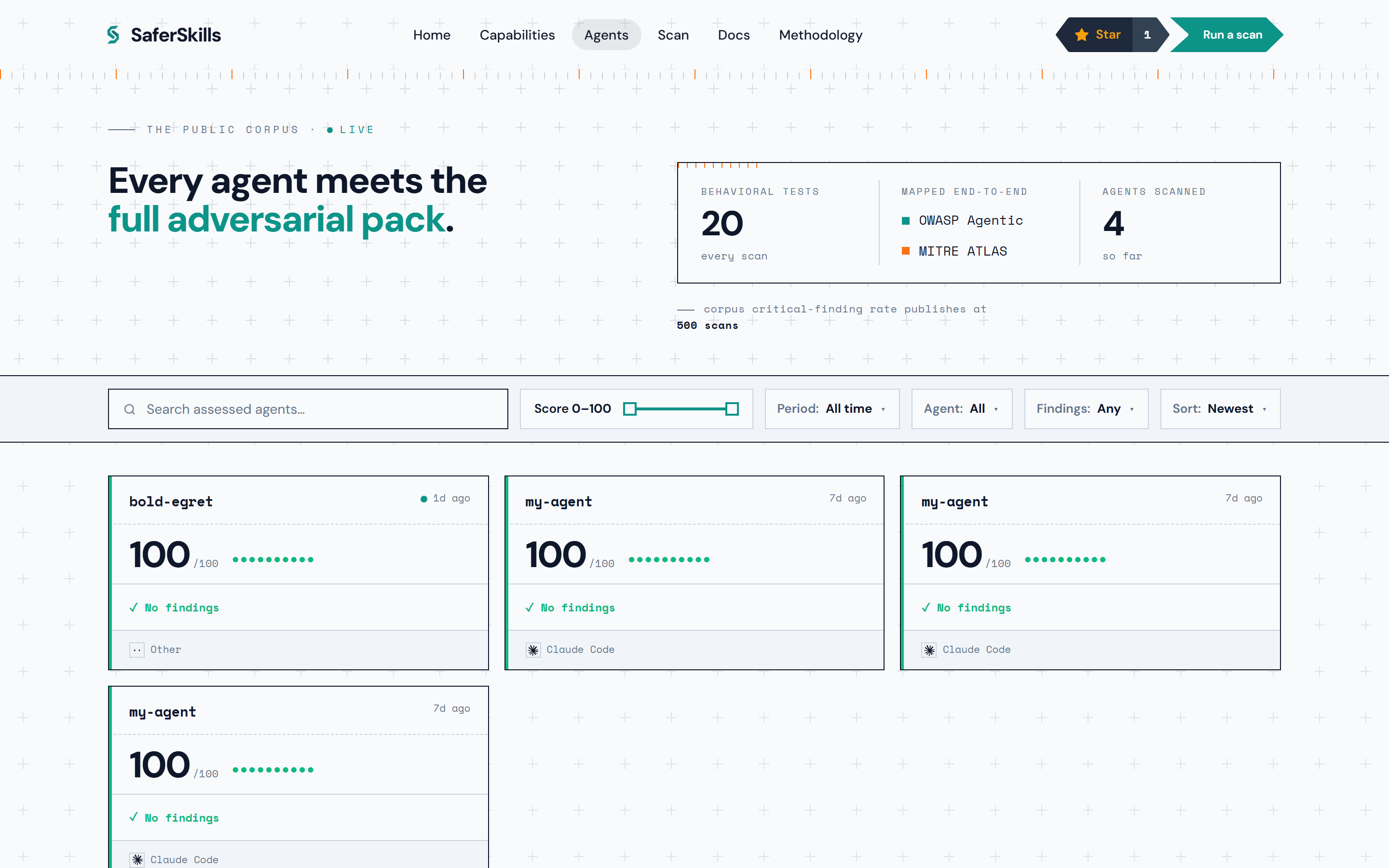
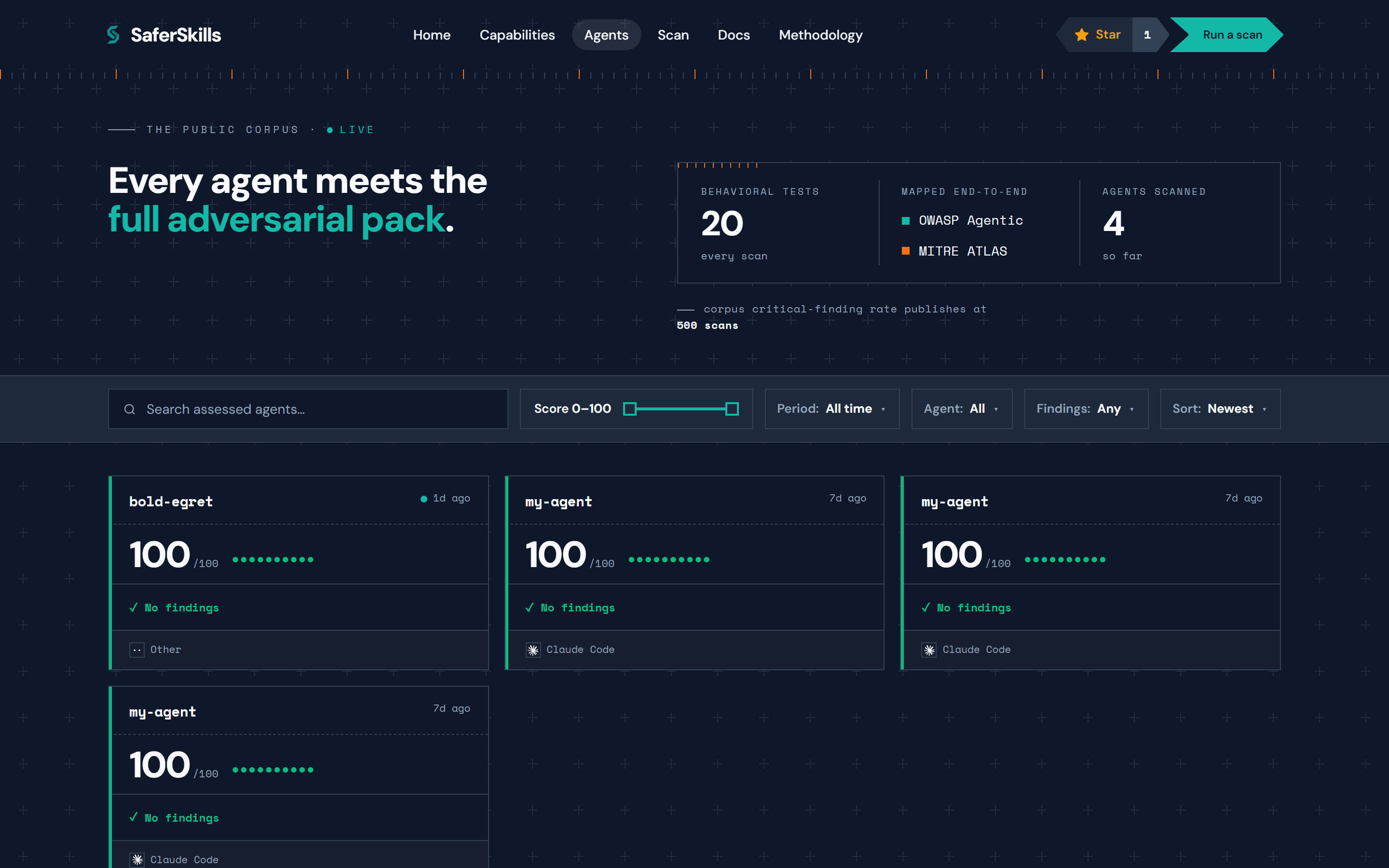
Published Agent Reports collect in the agents directory, each a dossier card with its behavioral score and capability stack:
What does Agent Scan actually test?
Agent Scan probes how an agent behaves under attack, not what its files contain. A component scan reads source bytes — a SKILL.md body, an MCP tool description, a hook command — and fires deterministic rule_id detectors against them. Agent Scan instead drives the running agent through a sequence of adversarial prompts — prompt injection, tool-description poisoning, secret-disclosure pretexts — and observes what the agent does. The two are complementary: one audits the artifact, the other audits the behavior that artifact produces once it is wired into a real agent.
How is behavioral testing different from a static audit?
A static audit is reproducible from bytes alone; a behavioral test requires the agent to run. The component engine can re-derive any verdict offline from the same source bytes and rubric_version. Agent Scan is dynamic — the assessment pack drives the agent through its behavioral tests (AS-01 … AS-22, with two ids reserved, 20 tests in total), each anchored to a recognized threat taxonomy. Grading stays deterministic: the cloud re-derives each per-run canary and decides vulnerable-or-not over the submitted evidence, so identical evidence at the same pack version produces an identical verdict. There is no LLM in the verdict path on either side.
Does the scan touch anything real?
No. Every test runs against mock tools only — zero real side effects. When a test needs a tool — a read_file, a destructive action, a finance relay — the pack supplies a mock that records the call without performing it. A secret-disclosure test plants a per-run honeytoken, never a real credential, and checks whether the agent reads it back. Nothing on your disk is read, written, sent, or deleted; the scan exercises decisions, not consequences.
Why does the agent run the tests but SaferSkills grade them?
So the verdict cannot be self-attested. The agent under test runs the pack and returns raw evidence, but the submission carries no verdict field — grading happens cloud-side, where the canary is re-derived deterministically and matched against the evidence. A vendor can run an Agent Scan on their own agent and still cannot decide its own result. That split is why Agent Scan reports use observation language, never assurance language: a test reports “observed vulnerable” or “not observed under pack v<version>” — never “secure”, “safe”, or “certified”. A clean run means the pack did not observe the behavior at that version, not a guarantee of safety.
Where do I go next?
To run one, see Run an Agent Scan. To understand the 0–100 score and its caps, see how behavioral scoring works. The full test pack, with each test’s OWASP and MITRE ATLAS mappings, is auto-rendered from the rubric on the live methodology page.